
Mobility hubs in focus
Insight into the potential of mobility hubs for better spatial and mobility decisions.
StraTopo supports governments and developers in strategically planning and substantiating mobility hubs. Through data-driven analyses, we provide insight into accessibility, travel patterns, and their relationship with the surrounding environment. This enables us to demonstrate where a mobility hub has the greatest impact, for whom, and under which conditions. In doing so, we support decisions that contribute to sustainable mobility, more efficient use of space, and a well-functioning network of walking, cycling, shared mobility, and public transport.
Whitepaper
Why mobility hubs do not work automatically
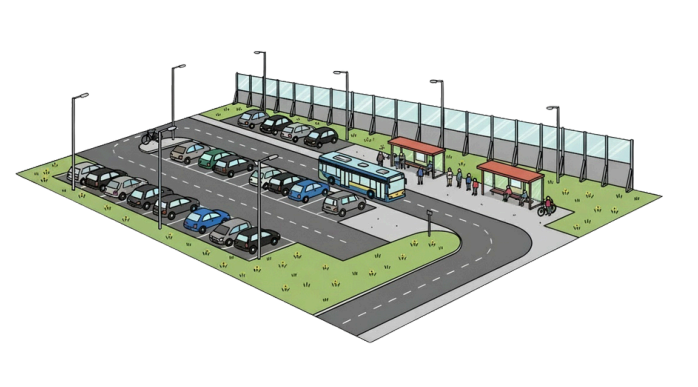
Mobility hubs are often seen as logical links between car, public transport, and bicycle. Yet in practice, their effectiveness is highly context-dependent. In some locations, hubs contribute to shorter and more predictable journeys, while elsewhere they have little impact or may even produce unintended side effects.
That difference rarely lies in a single mode of transport. It lies in the travel chain: the combination of travel time, reliability, transfers, and network connectivity. It is precisely there that mobility hubs make the difference — or remain underutilized.
The transfer as an alternative to congestion
In busy corridors, transferring at a mobility hub can be an attractive alternative to continuing by car during peak hours. Not because public transport or cycling is inherently faster, but because the travel chain offers stability where the network becomes congested.
On main corridors, delays accumulate. This increases not only travel time, but above all uncertainty. A well-positioned hub can break this chain and enable more predictable door-to-door journeys, resulting in reduced peak congestion.
Comparing door to door
At StraTopo, we analyze mobility as a complete travel chain. For each origin and destination, we compare direct trips with journeys via a mobility hub.
In doing so, we take into account, among other factors:
-
peak-hour delays,
-
transfer times,
-
public transport connections,
-
cycling reach and accessibility.
This results in an objective comparison that shows where a hub truly delivers added value, and for which trips or target groups this applies.
Small interventions, major impact
The attractiveness of a mobility hub is often determined by relatively small interventions. Think of improved cycling access, an adjusted public transport connection, or a temporary change in the network.
Welke factoren doorslaggevend zijn, verschilt per locatie. Wat we wel zien: juist deze gerichte ingrepen maken vaak het verschil tussen theoretische potentie en daadwerkelijk gebruik. Door scenario’s door te rekenen wordt zichtbaar welke aanpassing het meeste effect heeft.
Our approach in three steps
Our analysis of mobility hubs follows a structured and concise approach:
-
Huidige werking
Inzicht in het huidige gebruik en de prestaties van de hub, op basis van locatie-specifieke data. -
Potential
Exploring what is possible when accessibility, connections, or network conditions change. -
Scenarios
Comparing choices and impacts to support decision-making.
By combining data-driven analysis with knowledge of travel behavior, a transparent and explainable insight emerges that supports policy and design decisions.
The opportunity of the mobility hub
Mobility hubs offer opportunities to organize accessibility more intelligently, provided they are carefully analyzed and positioned. By combining context, travel chains, and scenarios, a robust foundation for decision-making emerges.
Would you like to know what a mobility hub could mean for your location? StraTopo helps make its potential clear and substantiate choices with data and analysis.

